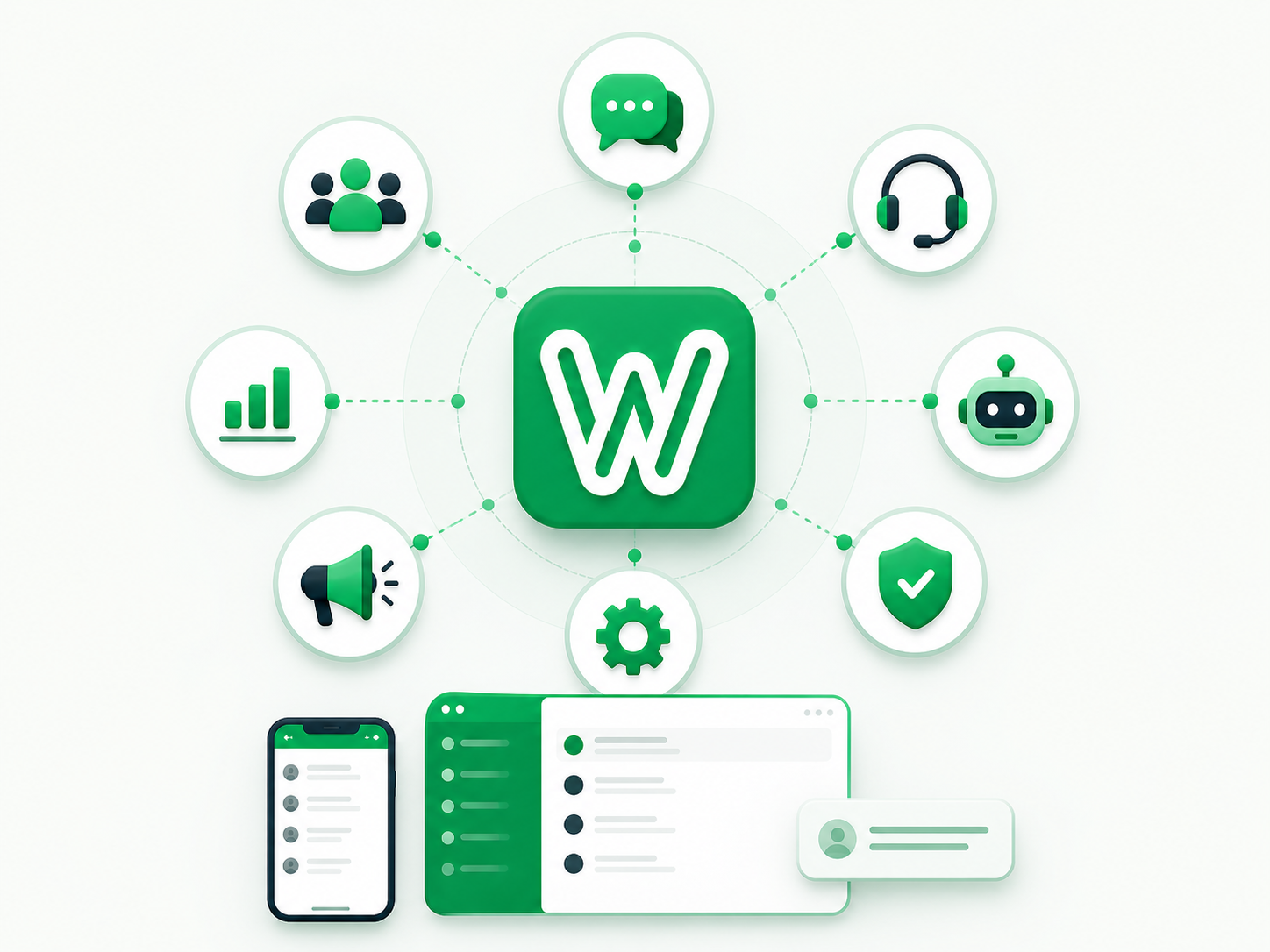
To manage multiple WhatsApp numbers and branches from one platform, define the purpose of each number, place it under the correct Meta Business Portfolio and WABA, and represent it as a channel with an owner, access scope, routing rules, and reporting. Do not give every employee access to every number, and do not treat each number as having its own messaging-limit allowance; the current limit is shared at portfolio level.
Executive summary
Ask why another number is needed before asking how to connect it.
Keep Meta asset ownership with the company, then turn each phone number into a clearly named operating channel in Wats.
Design role and channel access before inviting the team, and verify the result with restricted accounts.
Coordinate campaigns, templates, and messaging capacity across the whole Business Portfolio.
Measure both the channel and the customer journey; one person may interact with several branches or a central support team.
When is a separate phone number justified?
Several physical locations do not automatically require several WhatsApp numbers. A new number is useful when it creates a distinction customers understand and the team can operate consistently.
Operating question | A central number is often clearer when | Separate numbers may be justified when |
|---|---|---|
Brand identity | The brand and service promise are consistent | Brands or commercial identities are clearly different |
Working hours | One team covers the whole business | Each location has distinct hours and duty ownership |
Customer request | Internal routing can determine destination | Customers must choose a location or service at the start |
Conversation ownership | One team follows the customer end to end | Independent teams own outcomes and follow-up |
Language or region | A central team supports all variants | A region or language has a genuinely different journey |
Accountability | Unified reporting is the priority | Each scope is operationally accountable for its own queue |
Do not add numbers merely to “increase sending capacity.” Numbers in the same Business Portfolio do not receive independent messaging-limit pools. More numbers can also split the customer's relationship with the business across several message threads.
Understand the hierarchy before naming channels
Meta's 2026 best-practices guide for WhatsApp marketing messages explains that a business can have multiple Business Portfolios, a portfolio can contain one or more WhatsApp Business Accounts, and a WABA can hold multiple phone numbers. It also recommends avoiding unnecessary accounts and numbers so management and customer continuity remain simpler.
Layer | What it represents | Decision to document |
|---|---|---|
Meta Business Portfolio | Company ownership of Meta assets and the scope associated with the messaging limit | Who owns it, and who can administer WhatsApp assets? |
WhatsApp Business Account (WABA) | Container for WhatsApp assets such as phone numbers, templates, Flows, and catalog management, depending on setup | Why is this WABA used, and is separation from another account intentional? |
Business phone number | Customer-facing messaging identity | Which service or location does it represent, and who owns follow-up? |
Wats channel | Operating representation of the phone number inside the company | Internal name, team, templates, campaigns, and connection state |
Member channel scope | Channels on which a user can work | All channels or a selected list, and under which role? |
If those layers are not yet clear, start with the guide to connecting WhatsApp Business Platform to Meta before onboarding another number.
Messaging capacity is shared across the portfolio
The most important current constraint for a branch model is that Meta sets the messaging limit at Business Portfolio level and shares it across the WhatsApp phone numbers the portfolio owns. Meta's messaging limits documentation describes the limit in terms of unique users reached outside customer service windows during a moving period.
Operationally, that means:
A large campaign from one branch number can consume capacity needed by the other numbers.
Branches should not schedule campaigns independently without a portfolio-wide view.
A dashboard may display the limit next to a selected phone number, but that does not create a number-specific allowance.
Phone and template quality remain separate signals; available capacity does not make unexpected messaging safe or permitted.
A central owner should coordinate outbound volume even when campaign content is created by branch teams. The WhatsApp campaigns and templates guide covers the remaining audience, template, and launch controls.
Treat each channel as an operating unit
“Riyadh branch” is a helpful label, but it is not an operating design. Every channel should have a short charter that answers:
What is its main purpose: sales, support, bookings, or location-specific service?
Who owns quality, incidents, templates, and Meta follow-up?
Who can see unassigned conversations and who can reassign them?
What are the working hours, away response, and escalation path?
Which campaign types and templates may use the number?
Is success measured by channel, employee, or the customer's full journey?
What is the recovery plan if the current administrator leaves?
This prevents a business-owned number from becoming the practical property of “the person who knows the setup.”
Wats access matrix: combine role and channel scope
In Wats, membership belongs to a company and can cover every channel or a selected set. The role controls the type of work a person can perform within that allowed channel scope.
Role | Visibility and work in allowed channels | What the role should not be used for |
|---|---|---|
Owner | Full control, including company ownership, users, channels, and billing responsibilities | Routine branch work that does not require ownership |
Admin | Operational administration of users, channels, settings, and assignment | Granting broad access merely so a person can read conversations |
Assigner | View conversations in allowed channels and assign or reassign them | Billing or global configuration |
Seller | View unassigned conversations in scope and those assigned to their membership | Automatic access to other sellers' assigned conversations |
Do not stop at documenting this table. Sign in as a restricted seller, attempt to open a conversation from another branch, and test search, notifications, and assignment. The guide to WhatsApp sales and support permissions explains the broader separation between administration and daily use.
Hypothetical operating example: three branches with central support
This is a hypothetical example, not a real customer configuration or performance claim.
A Saudi retailer has locations in Riyadh, Jeddah, and Dammam plus a central support desk. It chooses a separate number for each branch because working hours, local availability, and follow-up ownership differ, while central support handles escalations from all locations.
Asset structure
One company-owned Meta Business Portfolio.
One WABA, because there is no documented legal or operational reason for more.
Three business phone numbers, each represented as a clearly named Wats channel.
No separate data entity called “branch”; the operating branch is modeled through channel name, access scope, and documented responsibility.
Team access
The owner and platform administrator can see all three channels.
A central support assigner has access to all channels so escalations can be reassigned.
Riyadh sellers are scoped to the Riyadh channel, Jeddah sellers to Jeddah, and Dammam sellers to Dammam.
A campaign operator does not receive channel administration simply because campaign audience work is part of the job.
Daily workflow
A customer messages the Jeddah number. The conversation appears unassigned within the Jeddah scope and is accepted by a local seller. If it becomes a support issue, the central assigner transfers it while the original channel and history remain clear. Before a month-end campaign, the company combines expected volume from all three branches because portfolio messaging capacity is shared.
Reporting
The business compares response and escalation metrics by channel but also uses the contact identity to understand the customer across channels where its data model permits. That avoids counting one person as three unrelated customers merely because they contacted several locations.
Failure patterns that make multi-number operations worse
Creating one number per employee
A number should represent a durable business function or customer journey, not today's employee. Staff turnover must not change the number customers know or the company's ability to recover the channel.
Giving everyone every channel
This removes the value of separation and increases the chance of replying from the wrong number or exposing conversations beyond a person's job. Begin with the smallest practical scope and expand deliberately.
Creating another WABA without a documented reason
Excess separation distributes templates, administration, and reporting across more assets. Use another account when ownership or operations genuinely require it, not as a fix for poor naming.
Comparing branches with different metric definitions
If one team measures response time from message arrival and another starts at assignment, the comparison is misleading. Define metrics centrally, then apply them to every channel. The guide to measuring WhatsApp performance provides a consistent measurement framework.
Launching from the available channel instead of the correct channel
Before sending, review the phone identity, audience, template, opt-in, and shared portfolio limit. The ability to select a channel does not mean that channel is suitable for the campaign.
How Wats supports multi-number operations
Wats synchronizes the company's connected Meta channels, shows number and connection state, and links each channel to inbox and campaign operations. Company administrators can grant a member all-channel access or select specific numbers, then apply the owner, admin, assigner, or seller role within that scope.
This structure represents a branch through channel scope; it does not claim a separate branch entity. The practical benefit is that the company can see which number is active, who can work on it, and where its conversations appear without deploying an independent platform account for each location.
Conclusion: add a scope before adding a number
Before onboarding another number, document the reason for separation, channel owner, intended WABA, member scope, escalation route, metric definitions, and the effect of campaigns on the shared Business Portfolio limit. If those answers are missing, the business has an operating-design problem rather than a phone-number shortage.
With clear identity, ownership, permissions, and reporting, one platform can support several numbers without mixing branches. Success is not the number of connected channels. It is whether each employee sees the right work, takes the right action, and leaves a usable record for the next person.